About

I earned my bachelor’s degree in Electrical Engineering from Shahid Beheshti University, where I studied control systems and optimization. My undergraduate thesis focused on optimizing PID-based frequency control in a smart grid with multiple energy sources.

I then completed a master’s degree in Information and Communication Technology at the Polytechnic University of Turin. During my master’s studies, I developed experience in machine learning, deep learning, network optimization, and the Internet of Things. I completed my thesis in collaboration with the University of Cologne, where I used machine learning and MRI-derived features to predict a molecular marker associated with brain tumors. This work introduced me to medical imaging and motivated me to continue research in this field.

I am currently a Ph.D. student in Computer Science and Engineering at the University of Connecticut. My research focuses on representation learning, diffusion models, and continual learning for 3D and 2D images, with an emphasis on building accurate, explainable, and reliable AI methods.

Education

  • Ph.D., Computer Science & Engineering — University of Connecticut, USA (2023–Present)
  • M.Sc., Information & Communication Technology — Politecnico di Torino, Italy (2019–2022)
  • B.Sc., Electrical Engineering — Shahid Beheshti University, Iran (2013–2018)

Research Experience

Graduate Research Assistant — University of Connecticut

Storrs, CT, USA · 2023 – Present

  • Designing a Bayesian Transformer + higher-order graph matching pipeline for cell tracking in serial tissue sections, supporting accurate 3D reconstructions for ultraplex imaging.
  • Developing CAPTURE and ImageReg — feature-based registration frameworks that combine SIFT/SURF-style keypoints with ResNet50 embeddings to analyze distortion and robustly align large biological image stacks.
  • Building reproducible evaluation pipelines, emphasizing uncertainty estimates, efficient GPU pipelines, and integration into downstream spatial analysis workflows.

Research Assistant — University of Cologne

Cologne, Germany · 2022 – 2023

  • Applied ML to radiomic MRI features to predict MGMT promoter methylation in glioblastoma, using 1153 Pyradiomics descriptors (including LoG and wavelet features).
  • Used XGBoost for feature selection and trained LR, SVM, and MLP models with nested cross-validation across FLAIR, T1w, T1Gd, and T2 sequences.
  • Managed end-to-end pipelines (data curation, preprocessing, documentation, GitHub) to ensure reproducible radiogenomics experiments.

Graduate Research Assistant — Politecnico di Torino

Turin, Italy · 2021 – 2022

  • Modeled relationships between particulate matter exposure and CNS disease mortality (Alzheimer’s, Parkinson’s) using regression and time-series forecasting.
  • Processed large environmental and epidemiological datasets to estimate region-level risk and identify spatiotemporal patterns.
  • Developed interactive dashboards that expose model outputs to clinical and public-health collaborators.

Publications

Selected peer-reviewed publications and submissions.

Projects

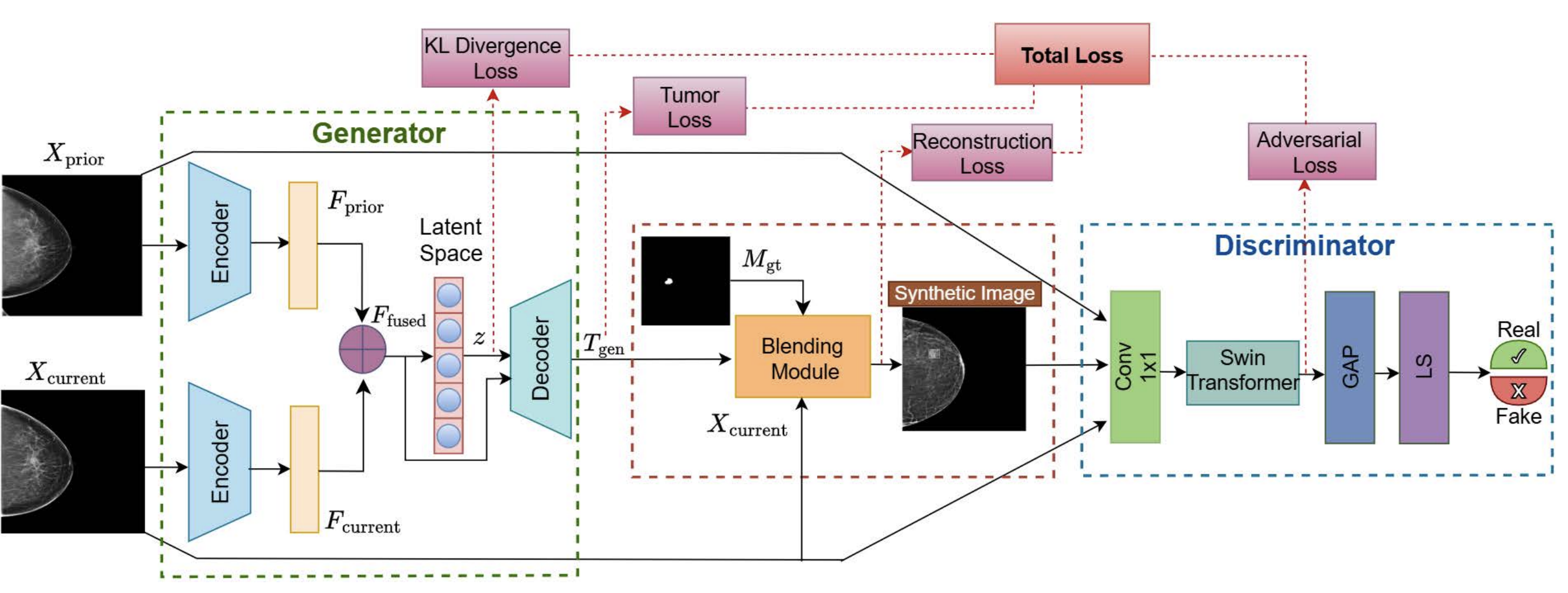
Overview of the longitudinal tumor generation framework (SynGAN)

Longitudinal Tumor Generation in Mammograms (SynGAN)

We introduce an end-to-end generative framework that synthesizes realistic tumor development in full-field digital mammograms by conditioning on prior and current normal exams. The model encodes each timepoint with Transformer-based feature extractors, samples diverse tumor appearances from a variational latent space, and reconstructs context-aware tumors using attention-based decoding. A differentiable soft-mask blending module inserts the synthesized tumor into the current mammogram to support longitudinal simulation and data augmentation.

Citation: A. Ahsan Jeny, S. Hamzehei, M. Karami, et al., “Longitudinal Tumor Generation in Mammograms via Dual Encoder GAN and Learnable Blending.” ACM BCB, 2025.
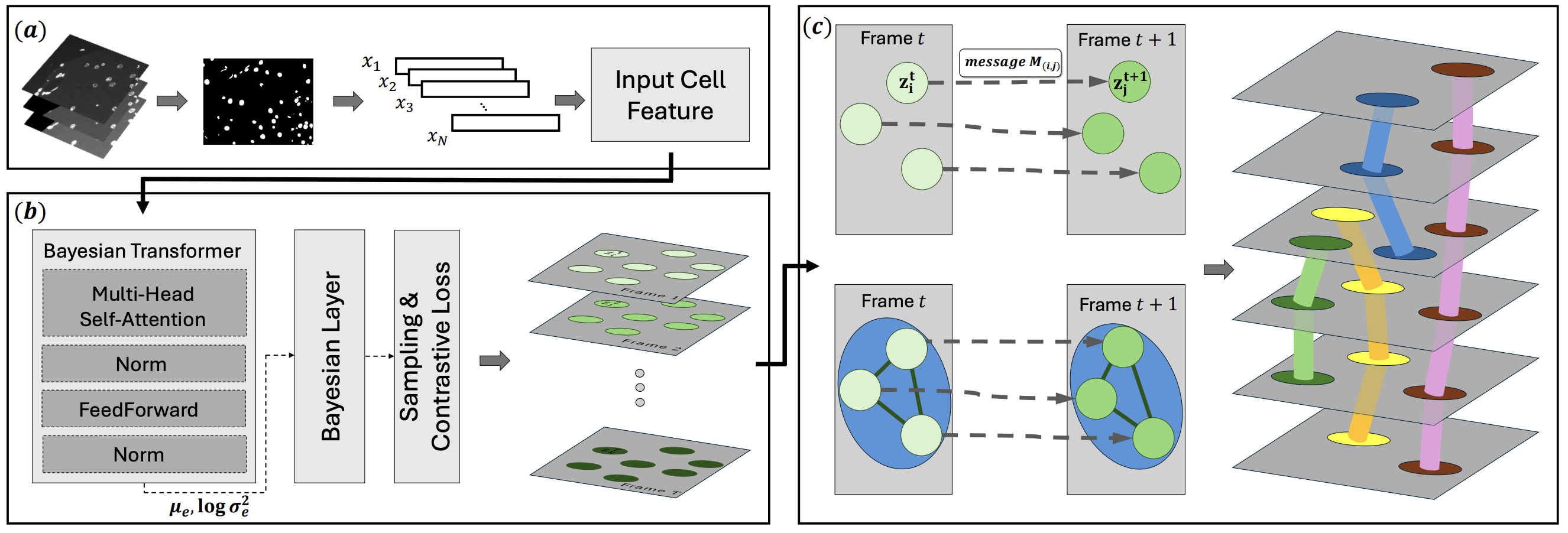
Overview of the Bayesian Transformer cell tracking framework

Bayesian Transformer Cell Tracking for Serial Tissue Sections

We propose a Bayesian Transformer tracking framework for highly noise-prone serial 2D multiplex tissue sections, where ultrathin slicing and alignment artifacts break conventional tracking. The approach uses uncertainty-aware feature embeddings (morphology, texture descriptors, and CNN features) and links cells across sections via higher-order graph matching with belief propagation. This enables more consistent cell trajectories and supports reliable 3D reconstruction of tissue organization, with validation on private multiplex data and public time-lapse microscopy.

Citation: M. Karami, S. Hamzehei, D. Arce, G. Raimondi, L. Ostroff, S. Nabavi, “Bayesian Transformers and Higher-Order Graph Matching for Cell Tracking in Serial Tissue Sections.” MICCAI, 2025.

Skills

  • Programming: Python, C/C++, MATLAB, JS, R, SQL.
  • Frameworks: PyTorch, TensorFlow, scikit-learn, Keras.
  • Tools: Git, VS Code, Docker, LaTeX.

Let’s Work Together

Have a project, idea, or collaboration in mind?